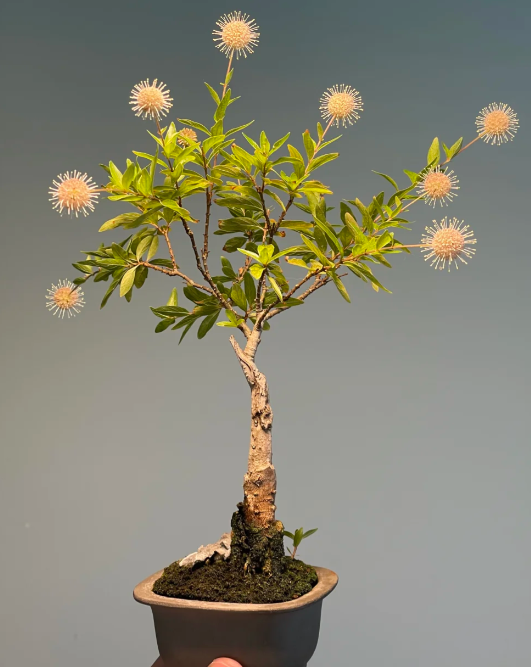
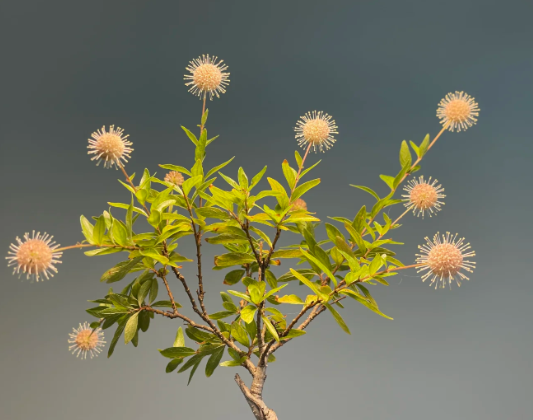
Adina pilulifera is a shrub to small tree. Its plant height is usually around 1 - 5 meters.
The trunk is usually upright, and the bark color is mostly gray - brown with longitudinal cracks.
Leaves
The leaves are opposite, generally thin - leathery in texture, and have various shapes, commonly ovate - lanceolate or ovate - elliptic.
The length of the leaves is usually between 3 - 12 cm, and the width is about 1.5 - 4 cm. The edges of the leaves have fine serrations, the leaf surface is dark green, the back of the leaf is slightly lighter in color, and the leaf veins are clearly visible.
Flowers
The capitulum is solitary or terminal, and the flower type is rather unique, spherical.
The color of the flowers is usually light yellow to white, and the flowering period is generally from late spring to early summer. The flowers are densely arranged on the inflorescence, which is very beautiful.
Fruits
It has capsules, which are purple - red when ripe and approximately spherical in shape. There are small seeds inside the fruits.
2. Growth environment
Climate
Adina pilulifera prefers warm and humid climate environments. It is relatively shade - tolerant and can grow well in semi - shaded environments, but it will grow more vigorously under sufficient light conditions.
It has a certain range of adaptability to temperature, generally growing well in subtropical and tropical regions, and has relatively weak cold - resistance and may grow poorly in low - temperature environments.
Soil
It doesn't have very strict requirements for soil, but it grows best in fertile, loose, and well - drained acidic soil.
It can grow in various natural environments such as stream banks, river beaches, mountain slopes, and thickets, and has a certain degree of moisture - tolerance and can thrive in moist soil environments.
3. Uses
Ornamental value
Adina pilulifera is a highly ornamental plant, often used in landscape design. Its spherical inflorescences are very eye - catching, and whether it is planted alone or in clusters, it can add a unique beauty to the garden.
It is also popular in bonsai making, and its unique tree shape and flowers can produce exquisite bonsai works.
Medicinal value
Its roots, stems, leaves, flowers, and other parts have certain medicinal values in traditional medicine. Generally, it has effects such as clearing heat and detoxifying, dispersing blood stasis and relieving pain, and is commonly used to treat colds, fevers, sore throats, bruises, and other diseases. However, professional guidance is required when using it for medicinal purposes.